Doing Business 2015 – Going Beyond Efficiency
is a flagship report from the World Bank Group based in Washington DC. This global thematic report measures business
regulations whether they enhance or constrain business activity in 189 economies
around the world (download report here).
Government with an efficient
bureaucracy plays a critical role in providing a right environment where
individuals and businesses will thrive.
Too much regulation is a recipe for economic stagnation whereas too
little regulation can lead to economic disaster (remember the Great Recession?).
In
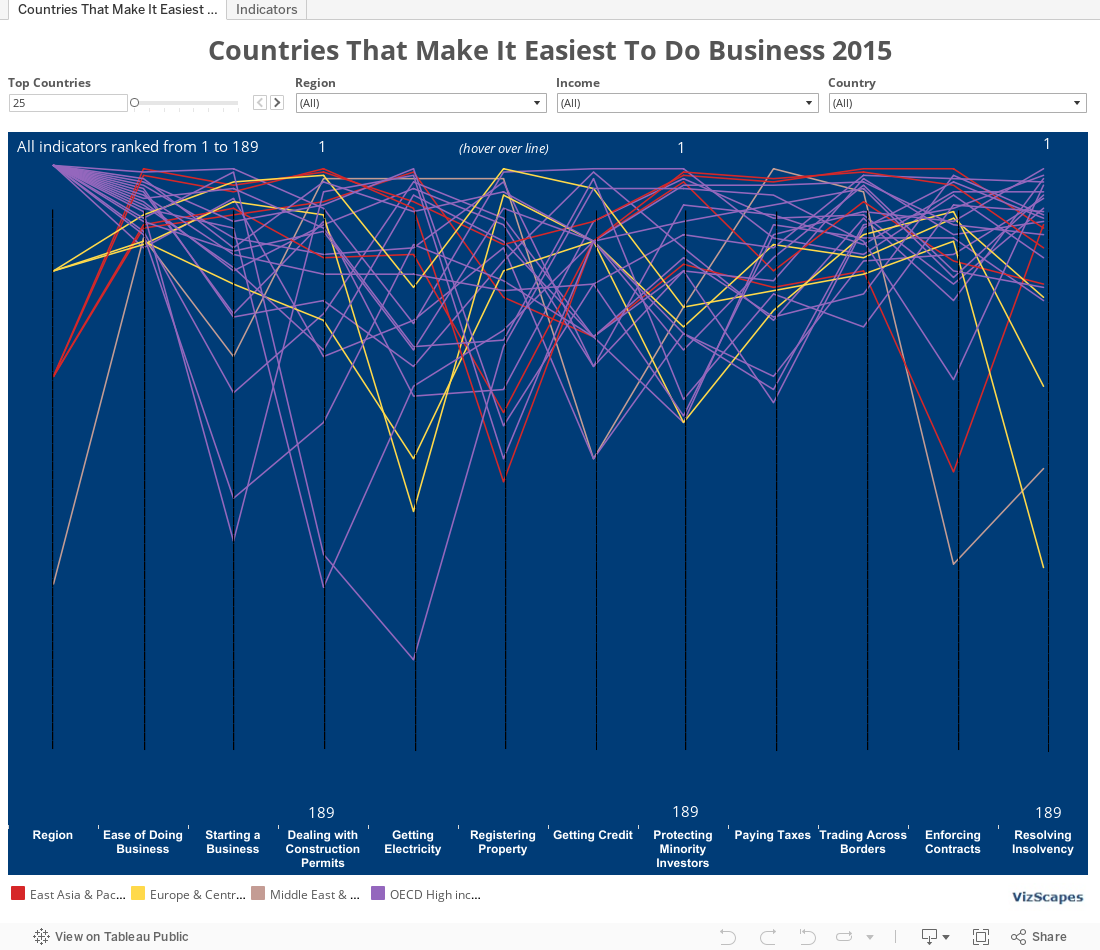
this report , the countries are ranked by the Ease of Doing Business
score, which is a composite of the
following 10 indicators: 1)
Starting a business, 2) Dealing with construction permits, 3) Getting electricity, 4) Registering property, 5) Trading across borders, 6)
Getting credit, 7) Protecting minority investors, 8) Enforcing contracts, 9) Resolving insolvency, & 10) Labor market regulation.
Parallel
coordinates were used to visualize this multi-dimensional data. The best way to utilize this visualization is
to filter the data by region, income, or country. Otherwise if all 189 countries were displayed,
the chart would become a colorful abstract visualization with too much
information!
The
top 3 economies that make it easiest to do business in 2015 are Singapore, New
Zealand, and Hong Kong, ranked 1, 2, and 3, respectively. Now go ahead and compare countries of your
choice to see which nation is more business-friendly so that you can open your
oversea office or start your business there!
First initiated by Goldman Sachs as an investment concept in
2001, BRICS (Brazil, Russia, India, China, & South Africa) are gaining
economic power and aiming to create a new political and economic order. To them, the current financial system lead by
the World Bank and the International Monetary Fund is out of touch and not
suited to support the world’s emerging markets. BRICS accounts for 30% of world’s territory
and 42% of world population. Four of the BRICS — China, India, Brazil
and Russia — are now ranked among the world’s 10 largest economies.
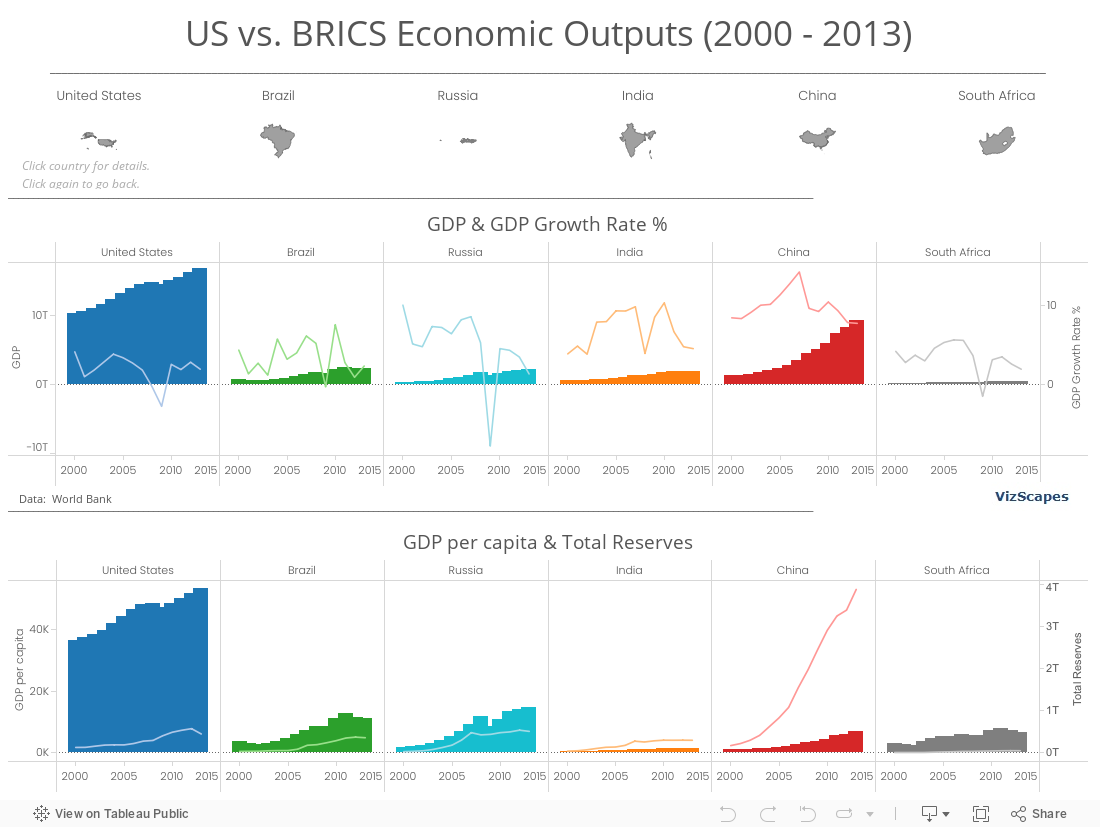
Let’s compare between the US and BRICS economic outputs. In 2000, the combined GDP of BRICS was only 26% of the US’ GDP. Thirteen years later in 2013, BRICS’ combined
GDP has climbed to 94% of the US’ GDP, with China’s GDP experiences the
sharpest increase. China’s GDP annual
growth rate is also highest among the US and other BRICS nations.
The US still commands the highest GDP per capita, whereas
China’s is still relatively low. However,
when analyzing the Total Reserves, China stands out for having the fastest
increase in total reserves from 2000-2013, and the highest total reserves in
2013 (6 times more than that of the US).
The huge total reserves not only can buffer China from drastic economic
upheavals, but also provide tremendous economic power.
With the launch of BRICS’ New Development Bank (NDB)
headquartered in Shanghai, I can’t wait to see the sibling rivalry of the World
Bank, the International Monetary Fund, and the NDB.