July 17, 2026

Brain Capital Age (Podcast)


Brain Capital Age (Podcast)


Genein Letford’s article "AI Didn't Create a New Era. It Revealed One." explores the transition into the Brain Capital Age, an era where cognitive health and unique human skills like creativity and empathy become our most valuable assets.  While artificial intelligence can replicate routine tasks, the author argues that over-reliance on technology risks weakening our critical thinking and mental resilience.  To combat this, engaging in the arts should build the cognitive reserves necessary to thrive alongside machines.  By engaging in music, storytelling, and visual arts, individuals can strengthen the neurological pathways that machines cannot easily imitate.  


June 12, 2026

Two Token Economies: From Satoshi to Jensen Huang (Podcast)


Two Token Economies: From Satoshi to Jensen Huang (Podcast)


GENAI ASSEMBLING and Thomas Luo’s article "Jensen Huang is the new Satoshi" explores the structural similarities between cryptocurrency and artificial intelligence through the lens of token economics.  While both industries convert computational power and electricity into valuable digital assets, the article highlights a shift from the speculative digital gold of crypto to the productive digital electricity of AI.  Jensen Huang and NVIDIA are framed as the modern successors to the anonymous Satoshi Nakamoto, transitioning from mere hardware providers to the primary architects of a global commodity market.  Unlike the artificial scarcity of Bitcoin, AI tokens are limited by physical infrastructure and thermodynamic constraints, making their value intrinsic to their immediate consumption.  Ultimately, the article argues that while crypto relies on shared belief, the AI economy is sustained by tangible utility and a relentless demand for automated reasoning.


May 15, 2026

ServiceNow: Putting AI to Work Across Enterprise (Podcast)


ServiceNow: Putting AI to Work Across Enterprise (Podcast)


The ServiceNow AI Platform provides a comprehensive ecosystem designed to unify enterprise workflows through advanced automation and machine learning.  By integrating artificial intelligence with real-time data, the system optimizes operations across diverse departments, including IT, human resources, and customer service.  The platform features autonomous AI agents and specialized tools like the Control Tower to manage governance and improve organizational productivity.  Furthermore, the company supports global businesses with an extensive library of educational resources, developer tools, and industry-specific solutions.  Ultimately, these services aim to streamline complex business processes while maintaining a high standard of security and transparency.


April 10, 2026

ServiceNow Agentic Business - Technical Foundation (Podcast)


ServiceNow Agentic Business - Technical Foundation (Podcast)


ServiceNow released a technical blueprint for transitioning from traditional software to an AI-native operating system for the enterprise.  This blueprint argues that while raw artificial intelligence is becoming a cheap commodity, the true competitive advantage lies in governed execution within the actual flow of business operations.
  The architecture is defined by four pillars - Sense, Decide, Act, and Govern - which allow autonomous agents to understand complex data and perform tasks across fragmented systems.  ServiceNow leverages its deeply embedded workflows and real-time operational data to provide a secure AI Control Tower.  This foundation ensures that autonomous work is auditable, compliant, and grounded in a company's unique institutional history.  Ultimately, ServiceNow is the essential platform required to safely manage the autonomous workforce of the future.


March 20, 2026

ServiceNow Agentic Business (Podcast)


ServiceNow Agentic Business (Podcast)


ServiceNow’s strategic vision for transitioning businesses into agentic enterprises by integrating AI directly into established operational workflows.  This blueprint emphasizes that autonomous execution requires a foundation of governance, identity, and cross-system orchestration.  The core of the proposal is the AI Control Tower, a framework designed to sense, decide, act, and govern across hundreds of fragmented applications.  The true value of enterprise AI lies in the trusted execution infrastructure that allows them to work safely at scale.


February 6, 2026

Software Disruption (Podcast)


Software Disruption (Podcast)


This week the software industry experienced a nearly $1 trillion selloff in the stock market.  It seems investors were concerned that AI is eating software and went on an indiscriminate selling.  


Doug O'Laughlin wrote an article "AI is Creating Peak Software, Media is the Best Analogyin July 2025 discussing about software disruption.  AI coding tools like Cursor and Claude Code, which automate complex, routine tasks, are slashing software creation costs, mirroring how YouTube disrupted linear TV.  As software supply explodes, traditional SaaS moats and high margins will vanish.  Value is shifting from commoditized code back to the physical scarcity of hardware.  


Do you think this software disruption justified or overreaching?


January 2, 2026

2026 AI Predictions (Podcast)


2026 AI Predictions (Podcast)


Scholars from Stanford University Human-Centered Artificial Intelligence and other disciplines predict 2026 will be defined by a shift from speculative hype to rigorous evaluation.  They anticipate that the industry will prioritize  tangible utility, transparency, and standardized benchmarks to measure the actual effectiveness of AI.  Key predictions include the rise of national AI sovereignty, the development of medical foundation models that rival current chatbots, and the implementation of real-time economic dashboards to track labor changes.  Rather than focusing solely on expansion, the focus is expected to turn toward opening the "black box" of neural networks and refining smaller, high-quality datasets.  Ultimately, the narrative moves away from asking what these technologies can do and toward understanding their long-term societal impact and return on investment.


Happy New Year everyone!


December 19, 2025

ServiceNow Supplier Lifecycle Operations (Podcast)


ServiceNow Supplier Lifecycle Operations (Podcast)


ServiceNow Supplier Lifecyle Operations (SLO) automates and simplifies interactions and collaboration across the end-to-end relationship with a supplier.  This allows for more seamless purchasing, primary data management, and performance management, across work teams and allows procurement and suppler managers to refocus on more strategic priorities.  Built on the Now Platform, Supplier Lifecycle Operations integrates seamlessly with existing ERP and procurement technologies to deliver faster time-to-value, while streamlining fulfillment and reducing the potential for errors or delays. 


Please visit ServiceNow, the AI platform for business transformation, to explore more about its portfolio of cost-saving products, now supercharged with AI agents.


November 28, 2025

ServiceNow Sourcing and Procurement Operations (Podcast)


ServiceNow Sourcing and Procurement Operations (Podcast)


ServiceNow Sourcing and Procurement Operations is a powerful solution that automates the source-to-receipt process for more seamless purchasing and case management across work teams, allowing sourcing and procurement to focus more on strategic priorities.  Built on the Now Platform, Procurement Service Management integrates seamlessly with existing ERP and procurement technologies to deliver faster time-to-value, while streamlining fulfillment and reducing the potential for errors or delays.


Please visit ServiceNow, the AI platform for business transformation, to explore more about its portfolio of time-saving products, now supercharged with AI agents.


October 24, 2025

Quantum Computing Breakthroughs


Two recent breakthroughs in quantum computing have added excitement to this cutting-edge technology.  The first achievement came from Google where a new quantum-algorithm Quantum Echoes, running on Google’s quantum chip Willow (~105 qbits), can achieve result 13,000 times faster than running on the current fastest supercomputer.  Crucially, the result is verifiable which means it can be repeated.


The second achievement came from IonQ, a leading quantum company, that demonstrates 99.99% two-qubit gate fidelity - meaning an error rate of less than ~1×10⁻⁴ per two-qubit operation.  This fidelity is considered a world record for two-qubit gates and a major step toward fault-tolerant quantum computing.  As fidelity improves, fewer errors must be addressed and more complex algorithms can be run.  In fact, IonQ’s roadmap projects logical two-qubit gate fidelity of 99.999% by end of 2025.


As more breakthroughs are achieved, quantum computing is moving from theoretical realm to commercial application world.  The next few years will be an exciting time as AI and quantum computing converge and enable advanced scientific discoveries.


October 17, 2025

ServiceNow Accounts Payable Operations (Podcast)


ServiceNow Accounts Payable Operations (Podcast)


ServiceNow Accounts Payable Operations is a process automation solution that helps finance departments to simplify and coordinate the activities required to pay suppliers accurately.  Now finance operations and accounts payable (AP) teams can eliminate mundane activities like entering emailed PDFs as invoices into backend systems, automate time-consuming processes like manually matching invoices with purchase orders and goods receipts, and focus on higher value activities.


Please visit ServiceNow, the AI platform for business transformation, to explore more about its portfolio of time-saving products, now supercharged with AI agents.


September 19, 2025

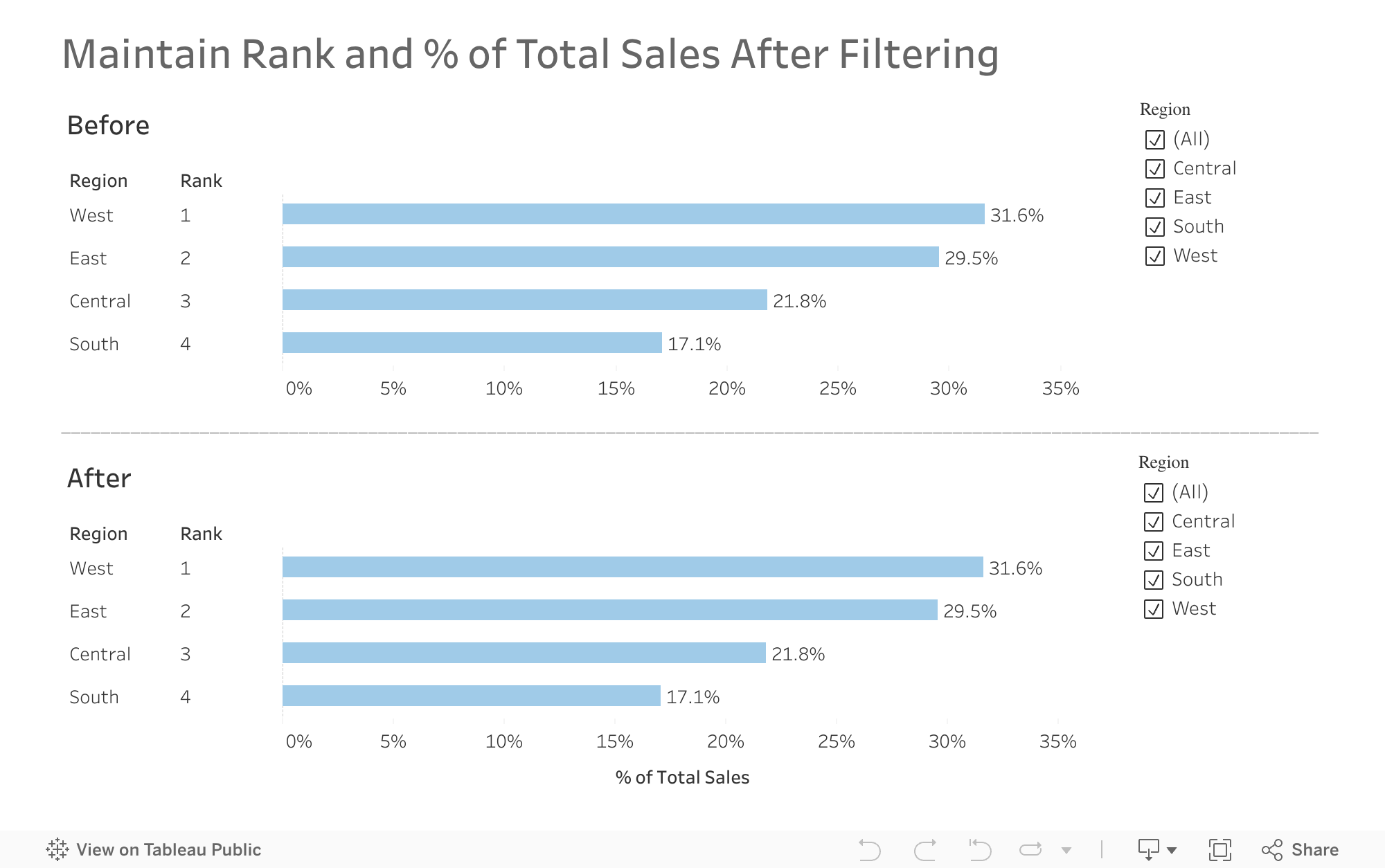
Maintain Rank and % of Total Sales After Filtering (Tableau)


Business Request:  In the bar chart, keep the rank and the % of total sales the same after filtering for specific region.


Solution:  


1)  To keep rank the same after filtering for Region, use the tip from this video:


a)  Create a formula ‘Region Filter’ with WINDOW_MIN function.


@Region Filter

WINDOW_MIN(ATTR(Region))


b)  Pull @Region Filter to the Filters pane and click ‘OK’ button.


c)  Click on down arrow in the ‘Region Filter’ and select Compute Using ‘Cell’.


d)  Select ‘Use all’ and then click ‘OK’ button.


e)  Use ‘Region Filter’ as filter.


2)  To keep the % of sales the same after filtering for Region, use the tip from this article:


a)  Create a formula ‘% of Total Sales’ using FIXED LOD.  The reason is FIXED LOD precedes dimension filter in Tableau order of operation.  This will ensure that when the Region filter is applied, the % of total sales is maintained because FIXED LOD precedes dimension filter.


@% of Total Sales

SUM(Sales) / AVG( { SUM(Sales) } )


b)  Use formula @% of Total Sales to create the bar chart.


Good luck everyone!


August 29, 2025

ServiceNow Strategic Portfolio Management (Podcast)


ServiceNow Strategic Portfolio Management (Podcast)


ServiceNow's Strategic Portfolio Management (SPM) solution helps organizations improve their digital transformation efforts.  It achieves this by aligning strategic goals with operational work, using a continuous and collaborative approach across the entire business.  The platform offers tools for strategic planning, resource alignment, and flexible work delivery, regardless of methodology.  This integrated system enhances visibility and responsiveness to change, ultimately maximizing value delivery and addressing the common failures of digital investments.


Please visit ServiceNow, the AI platform for business transformation, to explore more about its portfolio of superb products, now supercharged with AI agents.


August 15, 2025

Julius AI (Podcast)


Julius AI (Podcast)


Introducing Julius AI, an intelligent data analyst designed to streamline data analysis and speed up insights discovery.  The AI-powered product allows users to explore, interpret, and visualize data using natural language—no coding needed.  Julius AI emphasizes ease of use, robust security, and collaborative features, making it suitable for a wide range of professionals from finance to scientific research.  In addition, Julius can do data forecasting and statistical analyses, empowering users to uncover patterns, predict trends, and identity anomalies quickly.


Julius supports CSV/XLS, Google Sheets, PDF, text files and can connect directly to various data sources such as PostgreSQL, Google BigQuery, Microsoft OneDrive, Snowflake, Google Drive, GitHub, etc.


August 1, 2025

Model Context Protocol: Unifying AI Data Access (Podcast)


Model Context Protocol (Podcast)


The Model Context Protocol (MCP) is an open-source standard created by Anthropic to facilitate better connectivity between AI assistants and various data systems.  Historically, AI models have struggled with data isolation, requiring custom integrations for each new data source.  MCP aims to solve this issue by providing a universal protocol for secure, two-way data connections, enabling AI systems to access information from content repositories, business tools, and development environments more easily.  This allows AI models to produce more relevant responses by understanding the context around a task.  Developers can expose data through MCP servers or build AI applications that connect to these servers.


July 18, 2025

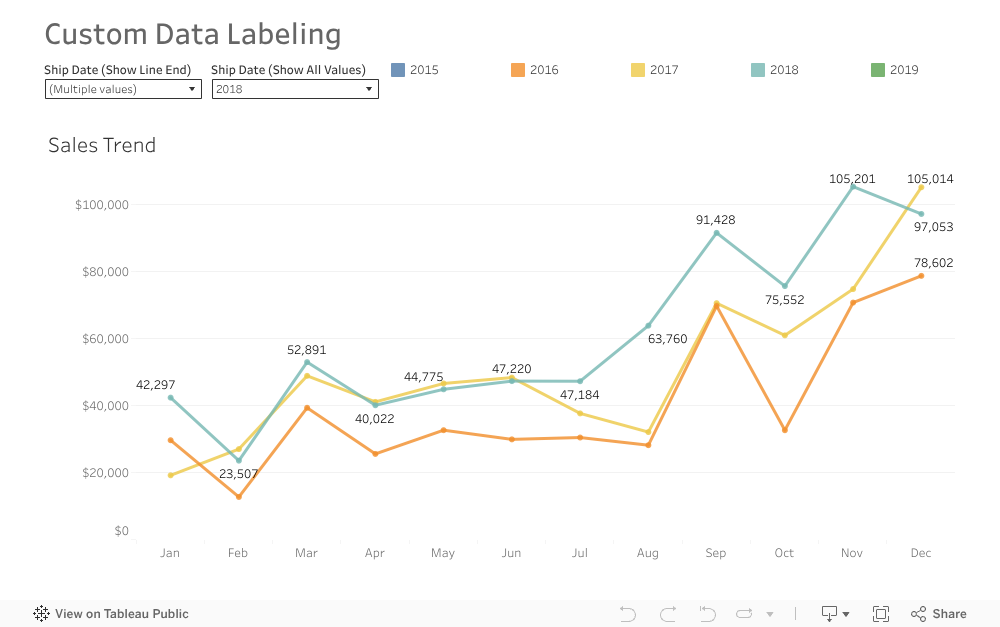
Custom Data Labeling for Line Chart (Tableau)


Business Request:  Customize data labeling where users can dynamically select what years to display value at line end and what years to display value for every month on line charts.


Solution:  We will use set selection and dual axis to customize the data labeling.


1)     Create a set for Year of Ship Date that will display values by line end in line chart (@Ship Date To Show Line End Set).


2)    Create another set for Year of Ship Date that will display values for every month in line chart (@Ship Date To Show All Values Set).


3)    Create formulas to calculate for sales based on each set.


@ Sales (Line End)

If [Ship Date To Show Line End Set] then [Sales] end


@ Sales (All Values)

If [Ship Date To Show All Values Set] then [Sales] end


4)    Use these 2 formulas to create a dual-axis line chart.


5)    Show sets for users to select years to display value at line end and to select years to display value for every month on line charts.


Many thanks to Jim Dehner for help with the solution.