October 23, 2015

October 2, 2015
Iran Nuclear Deal Survey
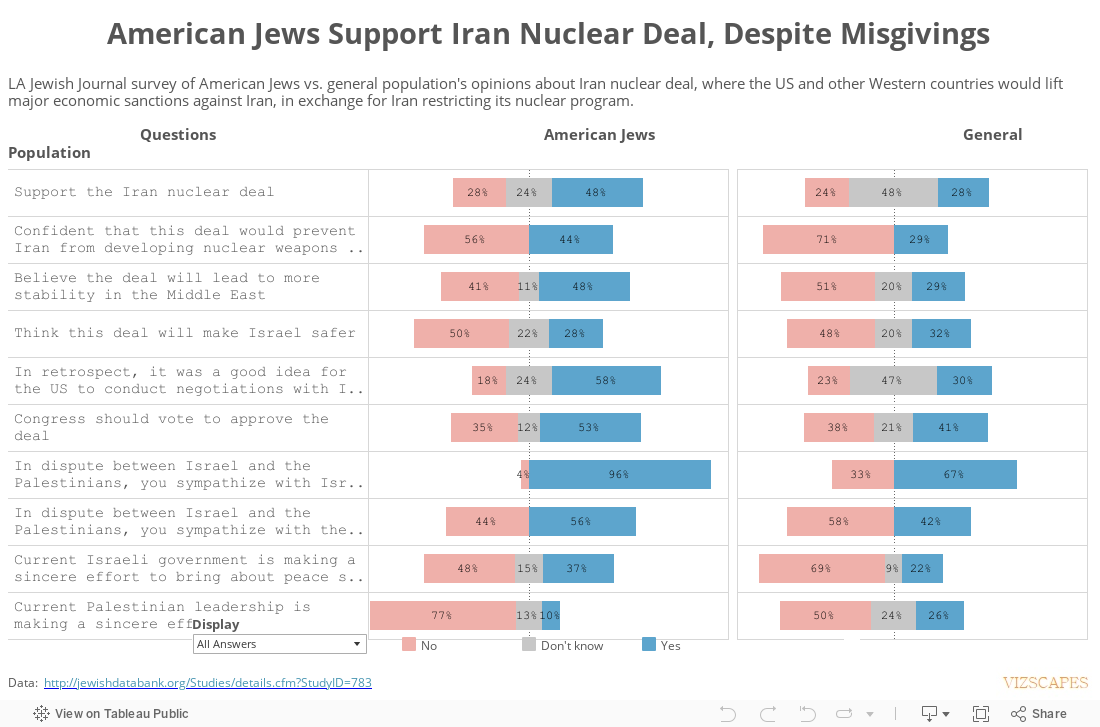
On July 14, 2015, Iran has reached a historic nuclear deal with the US, European Union, and China. The deal calls for Iran to restrict its nuclear program that makes it harder for the country to develop nuclear weapons in return for the US and other Western countries to lift major economic sanctions.
Between July 16-20, 2015, the LA Jewish Journal conducted a survey of American Jews and the general US population to find out what people think of the Iran nuclear deal. The result reveals that more American Jews (1) support the deal than oppose (48% vs. 28%), (2) want Congress to approve the deal (53% vs. 35%), and (3) think it was a good idea for the US to negotiate with Iran (58% vs. 18%).
For the general US population, (1) similar percentage support the deal as oppose (28% vs. 24%), with a large 48% don’t know enough to decide, (2) similar percentage want Congress to approve the deal as oppose (41% vs. 38%), and (3) slightly more percentage think it was a good idea for the US to negotiate with Iran (30% vs. 23%), with a large 47% don’t know.
Read here for the detailed analysis of the survey by Professor Steven M. Cohen. The findings show that despite misgivings by American Jews and in spite of opposition by Israel and many Jewish groups, most American Jews support the deal and want it approved.
*For standardization, answers 'Very confident' or 'Somewhat confident' & 'A lot' or 'Some' were grouped as 'Yes'; whereas 'Not confident at all' or 'Not so confident' & 'Not at all' or 'Not much' grouped as 'No'.
September 11, 2015
9/11 Memorial
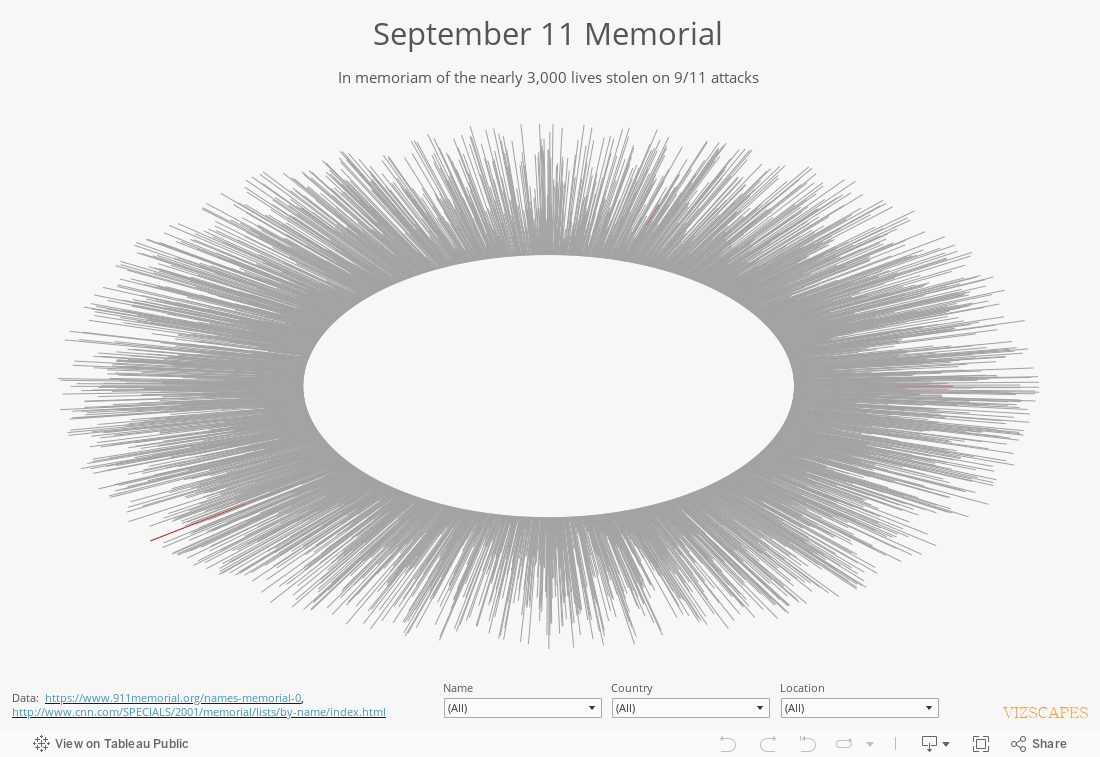
A contemplative visualization to remember the nearly 3,000 lives perished on September 11, 2001 attacks at the World Trade Center site, near Shanksville, Pennsylvania, and at the Pentagon.
 At the center of this visualization is an empty space that mimics
the National 9/11 Memorial design. The
blank space embodies the feeling of loss and absence from the taking of
thousands of lives on that pivotal day.
The single lines around the central void represent the lives stolen. Each line is like a candle and by hovering
over the line the name will appear, which is like lighting a candle in honor of
their life and their memory.
At the center of this visualization is an empty space that mimics
the National 9/11 Memorial design. The
blank space embodies the feeling of loss and absence from the taking of
thousands of lives on that pivotal day.
The single lines around the central void represent the lives stolen. Each line is like a candle and by hovering
over the line the name will appear, which is like lighting a candle in honor of
their life and their memory.

There are five red lines that personify the five youngest
victims age from 2 to 8. This color
selection is inspired by the moving image of the little girl in the red coat in
the movie Schindler’s List. Like the girl in the red coat that
represents the innocence of the Jews being slaughtered in the movie, the red
lines in the visualization highlight the innocence not only of the youngest
victims but also of the nearly 3,000 men and women lost in the 9/11 attacks.
This visualization is influenced by the work of Dave Hart.
August 14, 2015
Design Matters
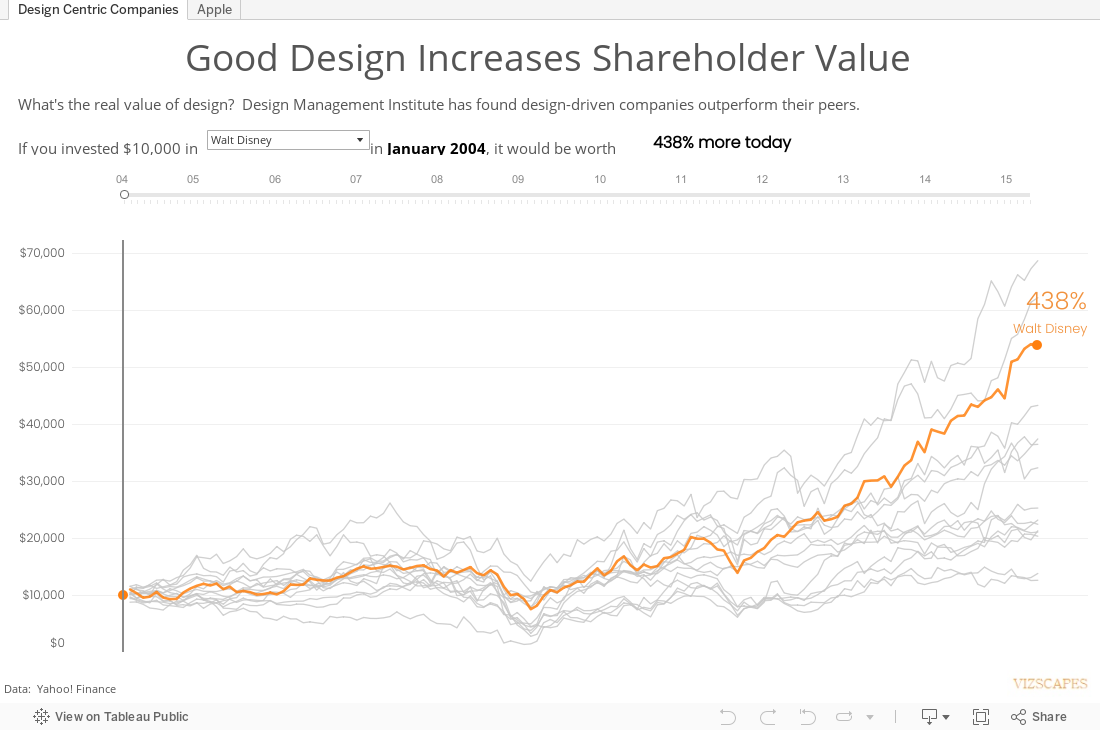
The Design Management Institute (in partnership with Motiv Strategies) has found that companies that integrate design into their products or services consistently produce strong financial return. Here’re the performances of sixteen design-driven companies that together make up the Design Value Index.
Apple which has integrated exceptional user-experience design into all its products produces spectacular stock return. Apple’s astounding performance is in a category by itself literally because including Apple with other companies in the same chart would simply destroy the curve.
A big thanks to Tableau Zen Master Kelly Martin for her work that laid the foundation for this viz.
July 17, 2015

June 19, 2015
May 22, 2015
Product Water Footprint
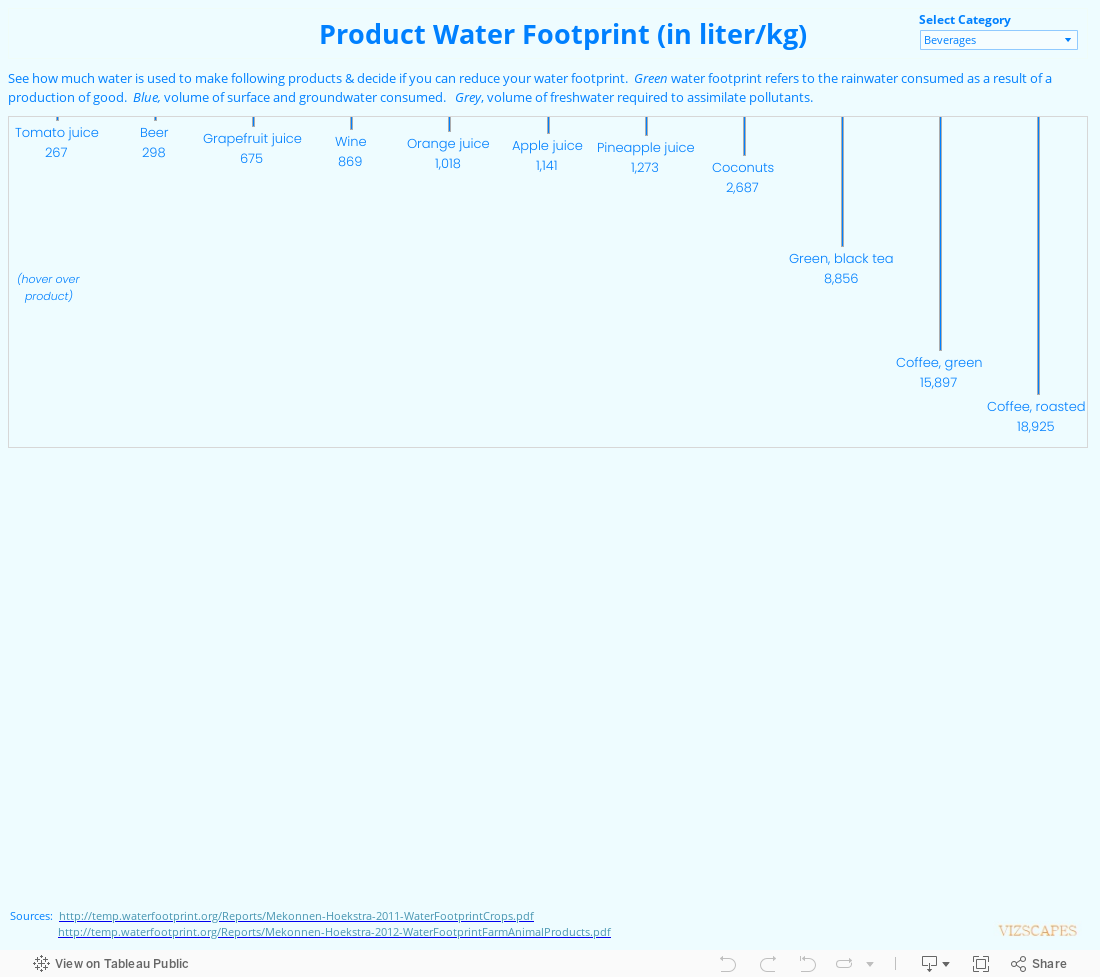
The Water Footprint Network based in the Netherlands is a non-profit foundation that connects with communities and partners interested in sustainable use of fresh water. The organization believes that sustainable use of fresh water is a critical foundation for healthy lives and a healthy planet.
The Water Footprint Network employs the water footprint as a method to measure how much water was used to produce each of the goods or services we consume. The water footprint looks at both direct and indirect water use of a product and includes water consumption and pollution through the full production cycle.
There are 3 types of water footprint:
1) Green water footprint: water from rain or precipitation. It is relevant for agricultural, horticultural and forestry products.
2) Blue water footprint: water from surface or groundwater. It is relevant for irrigated agriculture, industry and domestic water use.
3) Grey water footprint: amount of fresh water required to assimilate pollutants to meet specific water quality standards.
Let’s take a look at the water footprint for agricultural and farm animal products and determine if you can do your part to reduce your water footprint. Remember every drop counts!
Subscribe to:
Posts (Atom)