January 22, 2016

January 1, 2016
Transatlantic Trends
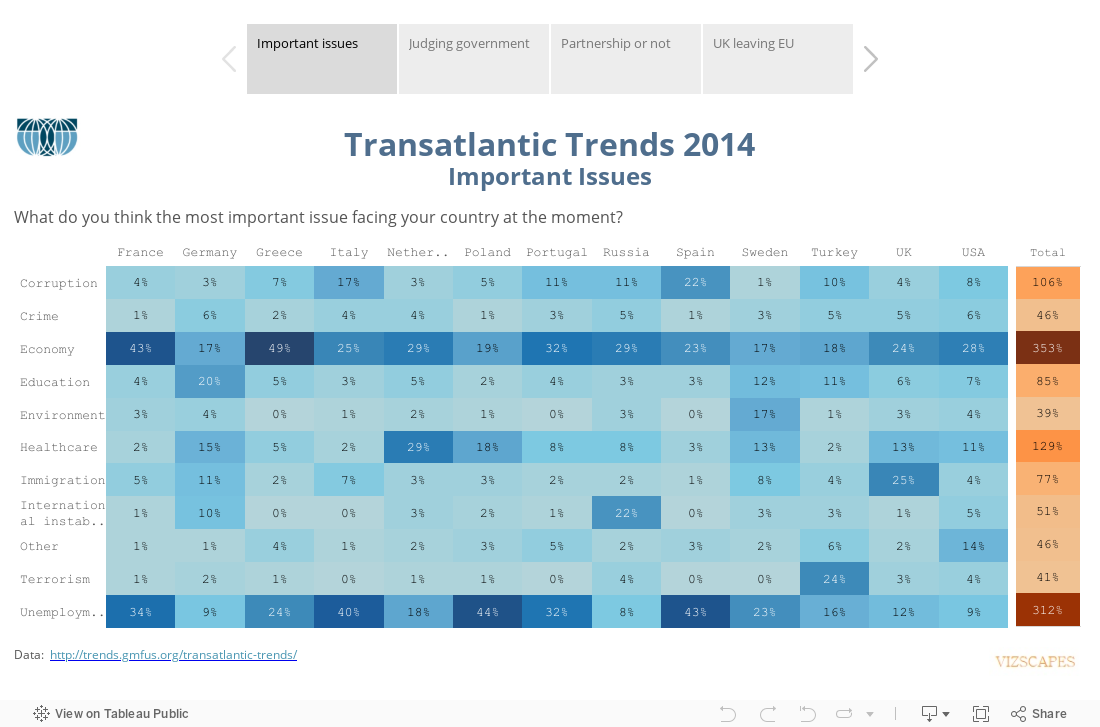
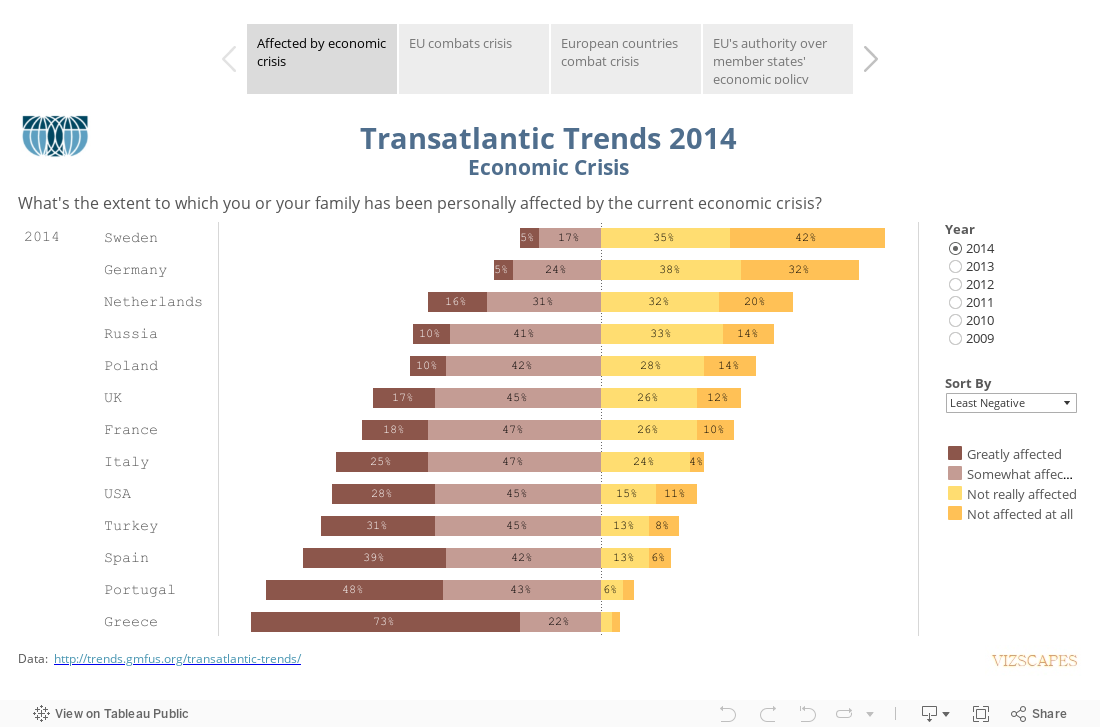
Happy New Year! Let’s start 2016 by reviewing the Transatlantic Trends report prepared by the German Marshall Fund of the United States based in Washington D.C. This global-thematic report is a comprehensive annual survey of American and European public opinion on numerous transatlantic issues, including foreign policies, support for NATO, economic performance, immigration etc.
This preeminent report provides valuable data for policymakers (including the U.S. Department of State), the media, & the academics to look into important issues that affect countries on both sides of the Atlantic. Here’s the first visualization that analyzes what people from the European Union, US, and Russia think about the important issues that are affecting their lives. Not surprisingly, the economy and unemployment were two most important issues on people's mind as these issues directly affected their financial well-being. On the issue whether the UK should leave the European Union, let's just say that there would be no love lost for the French if the UK decides to leave.
December 11, 2015

November 13, 2015
Singapore
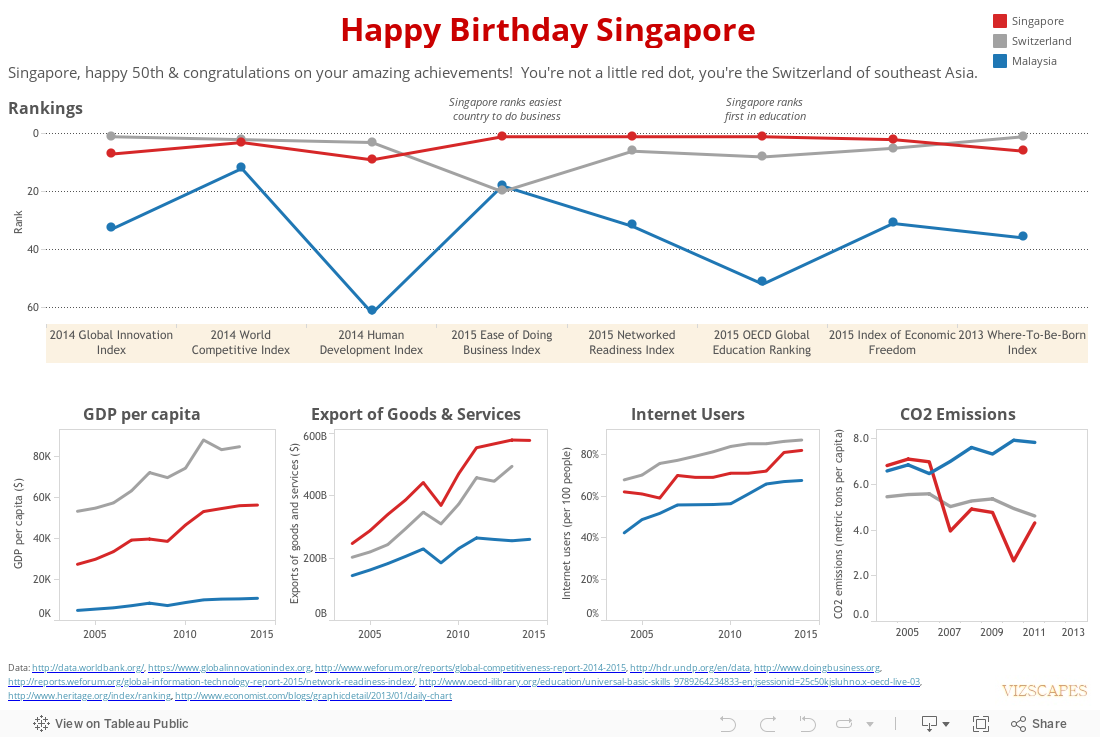
Fifty years ago, the Republic of Singapore gained independence as a nation after it was expelled from Malaysia. Since then, Singapore has marched ahead with its own rapid economic growth policy and the result has been impressive. Today Singapore is a highly developed country and the world’s fourth leading financial center. The country has the world’s highest percentage of millionaires, with one out of six households has at least $1 million in disposable wealth.

Along the way, Singapore was derisively referred as ‘the little red dot’ by then former President of Indonesia B.J. Habibie. The term was quickly adopted by both Singaporean politicians and citizens with pride as Singaporeans are proud of their economic success despite the country’s small size.
Happy birthday Singapore and congratulations on your laudable economic achievements!
October 23, 2015
G.I. Joe

Playing with action figure toys is an immersion in fantasy and a suspension of disbelief. Let’s look at the G.I. Joe action figures that make it possible for young players to enter into a wondrous state of play and make-believe.
In 1982, Hasbro re-launched the G.I. Joe: A Real American Hero line of action figures in smaller 3
¾” height, complete with vehicles, play sets, and a complex background story. This popular toy line which included of a
group of heroic, dedicated, fighting soldiers lasted for 12 years until it was
canceled in 1994. The G.I. Joe figures
have become American icons among toys and their appeal, stories, and concepts
have entered into American popular culture.
Here’re the 162 freedom fighters of the 1982-94 toy line
that most people identify with. Idea for
this visualization came from this G.I. Joe article.
October 2, 2015
Iran Nuclear Deal Survey
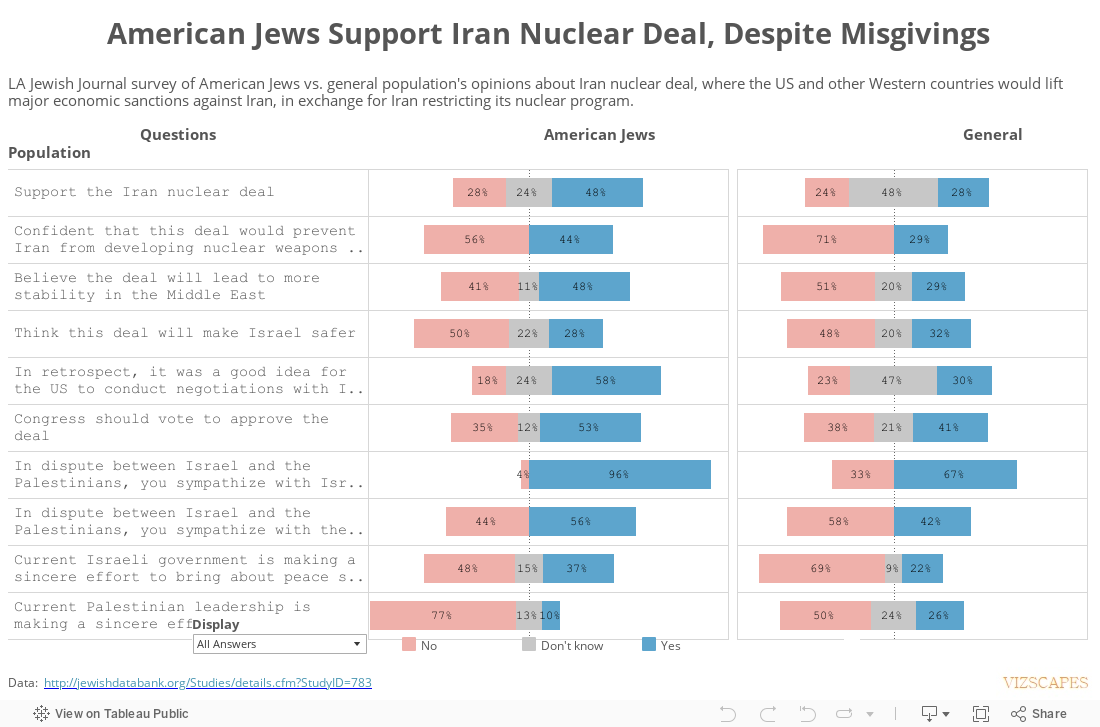
On July 14, 2015, Iran has reached a historic nuclear deal with the US, European Union, and China. The deal calls for Iran to restrict its nuclear program that makes it harder for the country to develop nuclear weapons in return for the US and other Western countries to lift major economic sanctions.
Between July 16-20, 2015, the LA Jewish Journal conducted a survey of American Jews and the general US population to find out what people think of the Iran nuclear deal. The result reveals that more American Jews (1) support the deal than oppose (48% vs. 28%), (2) want Congress to approve the deal (53% vs. 35%), and (3) think it was a good idea for the US to negotiate with Iran (58% vs. 18%).
For the general US population, (1) similar percentage support the deal as oppose (28% vs. 24%), with a large 48% don’t know enough to decide, (2) similar percentage want Congress to approve the deal as oppose (41% vs. 38%), and (3) slightly more percentage think it was a good idea for the US to negotiate with Iran (30% vs. 23%), with a large 47% don’t know.
Read here for the detailed analysis of the survey by Professor Steven M. Cohen. The findings show that despite misgivings by American Jews and in spite of opposition by Israel and many Jewish groups, most American Jews support the deal and want it approved.
*For standardization, answers 'Very confident' or 'Somewhat confident' & 'A lot' or 'Some' were grouped as 'Yes'; whereas 'Not confident at all' or 'Not so confident' & 'Not at all' or 'Not much' grouped as 'No'.
September 11, 2015
9/11 Memorial
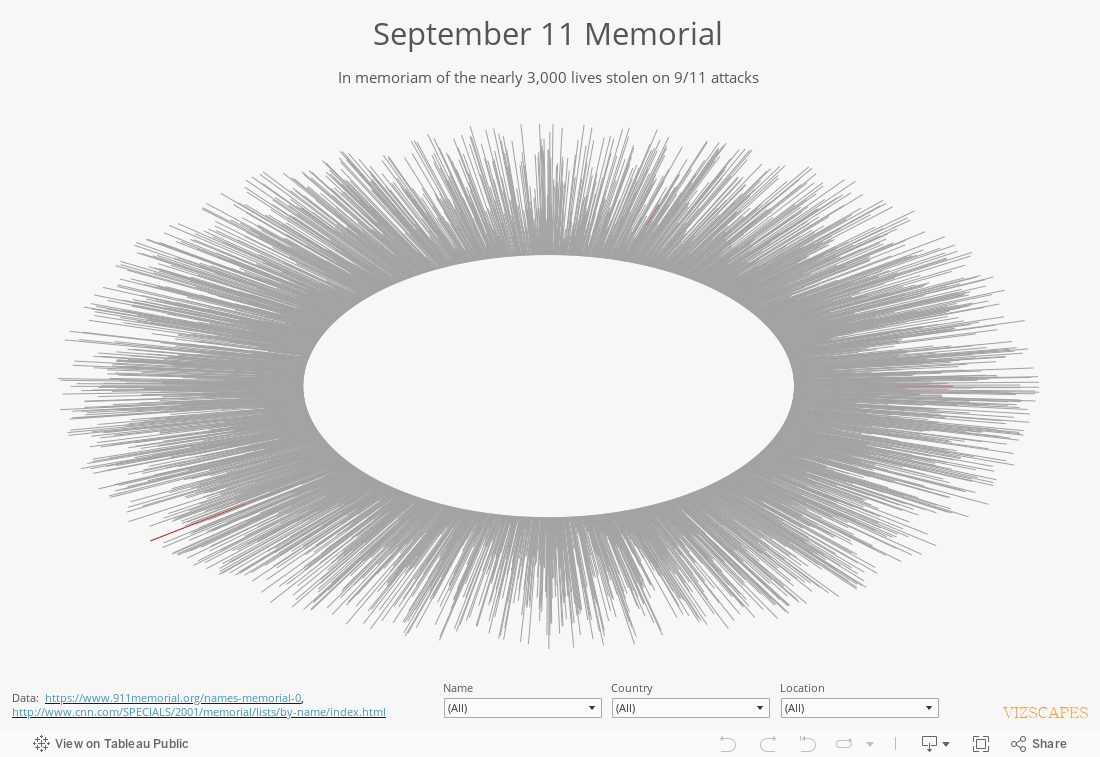
A contemplative visualization to remember the nearly 3,000 lives perished on September 11, 2001 attacks at the World Trade Center site, near Shanksville, Pennsylvania, and at the Pentagon.
 At the center of this visualization is an empty space that mimics
the National 9/11 Memorial design. The
blank space embodies the feeling of loss and absence from the taking of
thousands of lives on that pivotal day.
The single lines around the central void represent the lives stolen. Each line is like a candle and by hovering
over the line the name will appear, which is like lighting a candle in honor of
their life and their memory.
At the center of this visualization is an empty space that mimics
the National 9/11 Memorial design. The
blank space embodies the feeling of loss and absence from the taking of
thousands of lives on that pivotal day.
The single lines around the central void represent the lives stolen. Each line is like a candle and by hovering
over the line the name will appear, which is like lighting a candle in honor of
their life and their memory.

There are five red lines that personify the five youngest
victims age from 2 to 8. This color
selection is inspired by the moving image of the little girl in the red coat in
the movie Schindler’s List. Like the girl in the red coat that
represents the innocence of the Jews being slaughtered in the movie, the red
lines in the visualization highlight the innocence not only of the youngest
victims but also of the nearly 3,000 men and women lost in the 9/11 attacks.
This visualization is influenced by the work of Dave Hart.
Subscribe to:
Posts (Atom)